
Two Numbers Everyone Quotes, and the One They Skip

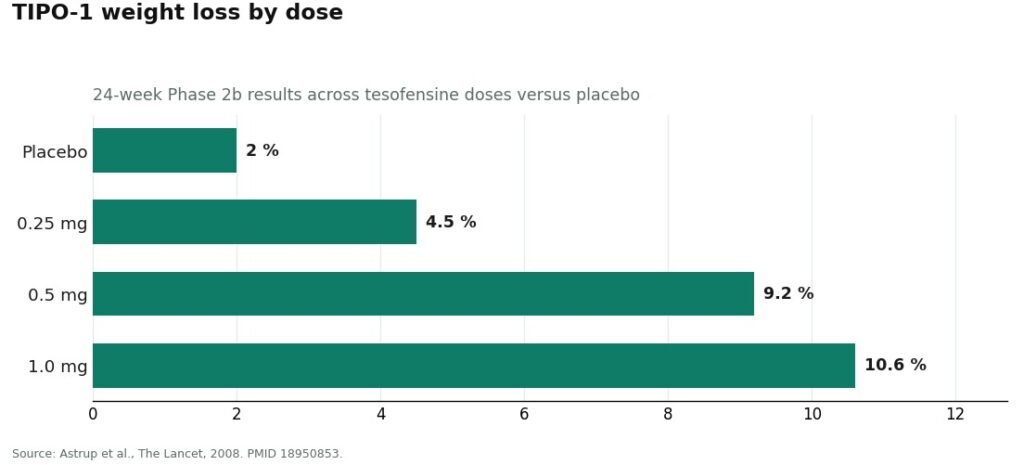
Here is the number people memorize about tesofensine: 10.6%. That is the body-weight loss recorded at the top dose in the 2008 TIPO-1 trial, and it is the number that gets repeated in every forum post about the compound [P1]. Here is the number almost nobody memorizes: 7.4. That is the rise in heart rate, in beats per minute, at the lower 0.5 mg dose in the same trial [P1]. One number sells the drug. The other number is why its own developers walked away from the dose that produced the bigger figure. I think that gap, between the number people chase and the number that actually decided the drug’s fate, explains almost every mistake I have seen people make when they try to combine tesofensine with something else.
Nobody needs to buy anything to follow this argument, and nothing here links to a shopping cart. Every claim traces to a primary source you can click through and read yourself.
The argument: one mechanism does double duty
Tesofensine is a triple monoamine reuptake inhibitor. It keeps serotonin, norepinephrine, and dopamine sitting in the synapse longer than they normally would, and that lingering is the entire reason appetite drops. Fine mechanism, straightforward story, except for one thing: two of those three chemicals, serotonin and norepinephrine, are also the exact systems that half the medicine cabinet already touches. SSRIs. SNRIs. Bupropion. Stimulant-based fat burners. Add tesofensine to any of those and you are not layering two separate effects. You are reinforcing one effect from two directions, and the body does not average that out gently.
The cardiovascular data backs this up independently. A separate 2008 meta-analysis of the earlier Parkinson’s and Alzheimer’s trials found the same dose-dependent heart-rate climb, up to about 6.8 bpm, in patients who were not even on a calorie-restricted diet, which tells you the effect belongs to the molecule itself, not to weight loss or lifestyle change riding along beside it [P2]. So before anyone mixes tesofensine with anything, the honest starting position is: this compound already spends part of its safety budget on the heart and the serotonin system, on its own, before you add a second variable.
Five ways the argument gets ignored in practice
The antidepressant left off the list. This is the mistake with the worst downside, and it happens for a boring reason: people stop thinking of their daily SSRI or SNRI as a “drug” the way they think of a new one. It is just part of the morning. Add tesofensine’s serotonin-reuptake blocking on top, and you have built the exact chemistry serotonin syndrome comes from. An MAOI in the mix adds a hypertensive crisis risk on top of that. The developers clearly understood the stakes here; the Saniona-run Phase 1 program built its entire design around tesofensine’s cardiovascular and pharmacologic profile [P5]. A clinician checking your medication list against that profile is not paperwork. It is the single check that prevents the worst version of this story.
The stimulant added to “boost” it. The logic sounds reasonable on its face: if tesofensine suppresses appetite, won’t a second appetite suppressant suppress it more? But tesofensine’s appetite effect rides on raised norepinephrine and dopamine, the same systems stimulants push. Stack them and you get more cardiovascular load, not more fat loss. The developers took heart rate seriously enough to run an entire trial pairing tesofensine with the beta blocker metoprolol, trying to cancel the heart-rate rise back out, a trial that ended up halted over safety concerns before closing in 2019 [P5]. Read that fact straight: the people who built this drug spent a study subtracting from its cardiovascular effect. Adding a stimulant runs the experiment backward.
Chasing the dose that made the headline. This is where the 10.6% number does its damage. It came from the 1.0 mg arm of TIPO-1, and that arm also carried the blood-pressure increase serious enough to get it dropped from later development [P1]. The doses that actually survived into further study were 0.25 and 0.5 mg, chosen specifically to keep cardiovascular effects in a livable range. So the “best” figure on the page belongs to the one dose the people who ran the trial decided was not worth what it cost. Someone measuring powder at home has no equivalent of a data safety monitoring board telling them to stop at 0.5.
Treating psychiatric silence as psychiatric clearance. Tesofensine touches three mood-relevant neurotransmitters at once, and the obesity trials excluded people with known psychiatric disorders [P1]. That is worth sitting with for a second: the published safety record is thin here, not reassuring. Absence of data is not evidence of safety, and on a compound built around serotonin, dopamine, and norepinephrine, the cautious reading is the correct one, especially for anyone already on medication for mood.
Assuming the vial matches the label. Every risk above assumes you know what you are actually dosing. On the research-chemical market, that assumption is unverified. Product labeled “research use only” has not been checked by the FDA for identity, strength, or purity, so any certificate of analysis you see is something the seller chose to hand you, not an independent check. Stack a carefully calculated combination on top of an unverified base dose, and your math was compromised before you started.
The counterpoint I have to give this argument
Someone could reasonably push back here: doesn’t this just describe every prescription drug with interaction warnings? Sure, plenty of medications carry serotonin syndrome warnings and dose ceilings. What’s different with tesofensine is that it has no FDA, EMA, or MHRA approval anywhere, so there is no approved label, no pharmacist double-check at a retail counter, and no built-in prompt asking about your other medications. The interaction risk isn’t unusual. The absence of any structural check on that risk is.
Where supervision actually earns its keep
Go back through the five mistakes and notice something: every one of them is something a clinician catches at intake or a follow-up visit, and none of them is something a chemical vendor catches, because a vendor’s job ends at the transaction. That is the practical case for going through a supervised model rather than a research-chemical listing.
FormBlends is a useful example of what that looks like in practice. Tesofensine there runs through a clinician evaluation, a prescription when warranted, and a licensed compounding pharmacy, in the range of roughly $90 to $300 a month depending on dose. One mechanical detail worth knowing: tesofensine is a small molecule, not a peptide, so it sidestepped the FDA’s peptide-compounding restrictions and stays available through licensed 503A pharmacies with a prescription. Map that model against the five mistakes and it lines up almost point for point: intake catches the antidepressant overlap, deliberate dosing keeps you off the 1.0 mg the trial abandoned, medication review catches stimulant stacking, history questions catch the psychiatric gap, and a licensed pharmacy removes the vial-contents guesswork. Patients who want harder data for their own check-ins can log dose and symptoms between visits, for instance with the FormBlends tracker app, which is a logging tool, nothing more, no prescribing and no checkout built into it.
HealthRX (healthrx.com) sits in the same supervised tier for the same reason: licensed clinical oversight ahead of any dispensing, medication going through actual pharmacy channels instead of a research-chemical listing. Choosing between the two mostly comes down to which one is licensed where you live and whose intake fits your situation.
The research-chemical route sits outside both of these, and it is worth being blunt about what that means: no clinician cross-checking your prescriptions, no one nudging you off the dose the developers dropped, no one confirming the vial is what it says. That is not a discount version of the supervised path. It is simply missing the checks that a compound with this particular risk profile needs.
Questions I keep getting asked
What’s the single worst thing to combine tesofensine with? Anything serotonergic, because tesofensine is already doing that job on its own. Stack an MAOI and you’re risking both serotonin syndrome and a hypertensive crisis; SSRIs, SNRIs, stimulants, and bupropion all overlap badly for the same reason [P5]. These are some of the most commonly prescribed drugs in the country, which is exactly why a real medication review matters before anyone starts.
Can I add a stimulant fat burner for a stronger effect? I’d call that one of the more dangerous combinations, not a clever one. Tesofensine already raises norepinephrine and dopamine, and heart rate is its most closely watched safety measure, watched closely enough that its developers ran a whole beta-blocker trial trying to bring it back down [P1][P5]. A stimulant pushes in the opposite direction from what that trial was trying to accomplish.
Why not go straight for the 1.0 mg dose with the best trial number? Because that’s the dose that got dropped for raising blood pressure too far. The doses that made it into further development were the lower 0.25 and 0.5 mg, chosen specifically to keep the cardiovascular numbers tolerable [P1]. The best-looking figure on paper is attached to the dose its own developers backed away from.
Does a history of depression change the calculation? Yes, and it should. Tesofensine raises three mood-relevant neurotransmitters at once, and the trials excluded people with a psychiatric history, so that group’s risk is genuinely uncharacterized rather than cleared [P1]. Missing data isn’t a green light. It’s a reason to have the conversation with a clinician before adding anything.
What is tesofensine and how does it work?
Tesofensine is a triple monoamine reuptake inhibitor. It slows how quickly the brain clears dopamine, norepinephrine, and serotonin, so all three linger longer than usual. It started life as a Parkinson’s and Alzheimer’s candidate and moved into obesity research only after trial participants kept losing weight as a side effect. That same three-pronged action is exactly why stacking it carelessly with other serotonergic or stimulant compounds is a real cardiovascular and neurological risk, not a theoretical one.
Does it actually burn fat, or just kill appetite?
The evidence points mostly toward appetite suppression rather than a direct fat-burning effect. The Phase II weight-loss numbers are real, but researchers attribute most of the effect to people simply eating less, not to a thermogenic mechanism. There’s some hint of a modest metabolic-rate bump, probably from the norepinephrine piece, but calling this a “fat burner” in the stimulant-thermogenic sense oversells what the data currently shows.
Is tesofensine a peptide?
No. It’s a small molecule, structurally and mechanistically nothing like a peptide such as semaglutide or a research compound like BPC-157. I think the confusion comes purely from seeing it listed next to peptides on the same supplier pages, but the categories, and the risk profiles when combined with other things, are genuinely different.
Where can someone actually get this legally?
As of this writing, tesofensine has no approved prescription status in the US, UK, or EU, which means most retail and online sources are operating in a legal gray zone with no quality oversight at all. Some physician-supervised compounding pharmacies work within existing regulatory frameworks to provide it under medical supervision, FormBlends being one example of that accountable route. Buying from a research-chemical vendor instead means no verification of dose, purity, or contamination, and on something this pharmacologically active, that gap matters.
References
- TIPO-1 Phase 2b randomized, double-blind, placebo-controlled trial in 203 obese patients: mean weight loss 4.5% / 9.2% / 10.6% at 0.25 / 0.5 / 1.0 mg vs 2.0% placebo over 24 weeks; heart rate +7.4 bpm at 0.5 mg; authors concluded the 0.5 mg result needs Phase 3 confirmation. Astrup et al., The Lancet, 2008. PMID 18950853. https://pubmed.ncbi.nlm.nih.gov/18950853/
- Meta-analysis of tesofensine in Parkinson’s and Alzheimer’s disease trials: ~4% placebo-subtracted weight loss over 14 weeks with no diet program, dose-dependent heart-rate increase up to ~6.8 bpm independent of weight loss. Astrup et al., Obesity (Silver Spring), 2008. PMID 18356831. https://pubmed.ncbi.nlm.nih.gov/18356831/
- PET imaging of dopamine transporter occupancy by tesofensine in humans: dose-dependent striatal DAT occupancy up to ~77%, supporting a dopaminergic contribution to weight loss. Appel et al., European Neuropsychopharmacology, 2014. PMID 24239329.
- Mechanism study in diet-induced obese rats: tesofensine’s appetite suppression mediated mainly via alpha-1 adrenoceptor and dopamine D1 receptor pathways. Axel, Mikkelsen, Hansen, Neuropsychopharmacology, 2010. PMID 20200509.
- Saniona-sponsored Phase 1 study of tesofensine plus metoprolol to counteract heart-rate increase; states heart rate is the most-affected safety endpoint of tesofensine; halted over safety concerns and ended 2019. NCT03488719.
- Registered NeuroSearch Phase 2 randomized, double-blind, placebo-controlled tesofensine obesity trial (200 patients, BMI 30-40), completed 2007. NCT00394667.